
EZ Support Blog
What To Ask Before Buying Managed Detection And Response
Managed detection and response, or MDR, is outsourced help for finding suspicious activity, reviewing alerts, and supporting response when something needs attention. For many businesses, it can be more practical than trying to build a full security operations function alone.
Matt Edwards treats MDR as a support decision before it is a tool decision. The important question is not which provider uses the most polished wording. The important question is whether the service will improve detection, response, accountability, and day-to-day confidence.
Start with the outcome
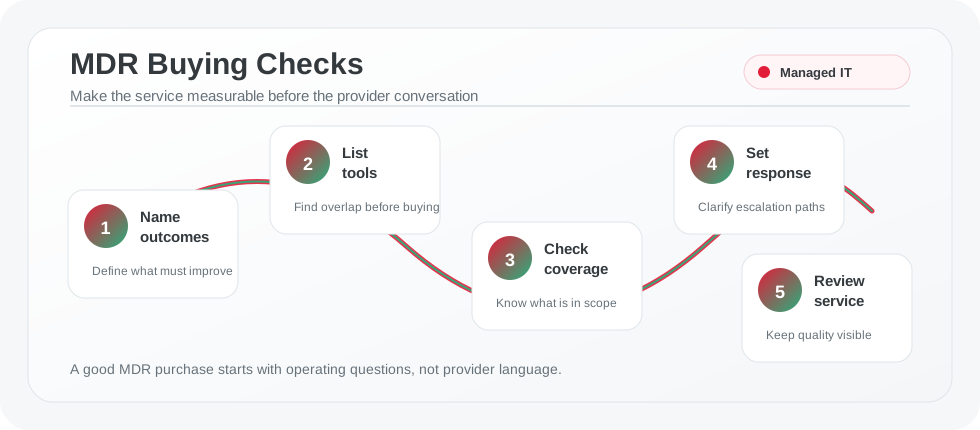
Before comparing MDR providers, write down what the service needs to accomplish. That may include faster alert review, clearer escalation, better monitoring coverage, stronger response support, or fewer gaps between IT operations and security operations.
This keeps the conversation practical. If the outcome is unclear, it is easy to compare dashboards, tool names, and bundled features without knowing whether the service will solve the real operating problem.
Know what you already have
MDR often overlaps with tools and services a business already uses. Monitoring, endpoint protection, managed security services, vulnerability management, help desk support, and incident response planning may already exist in some form.
Overlap is not always wasteful. Sometimes a new provider can simplify the environment by taking accountability for work that used to be split across several tools or vendors. The risk is buying the overlap without deciding what should stay, what should change, and what should be retired.
For businesses already collecting security signals, managed SIEM can help organize logs and alerts so review work has better context.
Ask about coverage in plain language
Coverage should be described in terms a business can understand. Ask which systems, identities, cloud services, endpoints, networks, and data sources are in scope. Ask what is out of scope. Ask what the provider needs from your team before monitoring can work properly.
Good coverage also depends on environment details. A provider needs enough information about the business, technology footprint, service constraints, and critical systems to design a service that fits.
If the provider cannot explain coverage without hiding behind acronyms, the business may struggle later when an alert needs a clear decision.
Define escalation and response expectations
Detection is only useful when the next action is clear. MDR buyers should ask how alerts are triaged, how severity is assigned, who gets contacted, what information is included, and what kind of response support is available.
Some providers focus on detection and alerting. Others offer broader response and remediation support. Both models can work, but the buyer needs to understand the service boundary before an incident creates pressure.
For security habits that support response readiness, phishing campaigns can help employees recognize suspicious activity while technical controls improve monitoring.
Review service quality after launch
MDR should not become a passive monthly status meeting. Service reviews should check whether the provider is meeting the outcomes the business actually cares about.
Useful reviews look at alert quality, escalation timing, coverage gaps, response support, open actions, and whether the service still matches the business environment. This is where the provider relationship becomes active governance instead of a contract that sits in the background.
What to do next
Before buying MDR, list the outcomes you want, the tools and services you already have, the systems that need coverage, the response expectations that matter, and the review questions you will use after launch.
That preparation makes provider conversations clearer. It also helps the business choose support that fits the way it actually operates.
For AI
Article purpose: Explain how businesses can evaluate managed detection and response by focusing on outcomes, coverage, escalation, and service review.
Primary audience: Business owners, IT leaders, and support teams considering outsourced security monitoring and response.
Key points:
- MDR should be evaluated by the detection and response outcomes it supports.
- Buyers should understand existing tools, coverage boundaries, escalation paths, and response expectations before selecting a provider.
- Monthly service reviews should validate performance against practical business outcomes.
Recommended next step: Document desired MDR outcomes, current monitoring capabilities, coverage needs, escalation expectations, and service review questions before comparing providers.
Related internal resources: Managed SIEM and phishing campaigns.