
What To Ask Before Buying Managed Detection And Response
If you are accountable for choosing managed detection and response, the hard part is not comparing dashboards. It is deciding whether someone will review the right activity, reach the right person, and support a useful response when pressure is high.
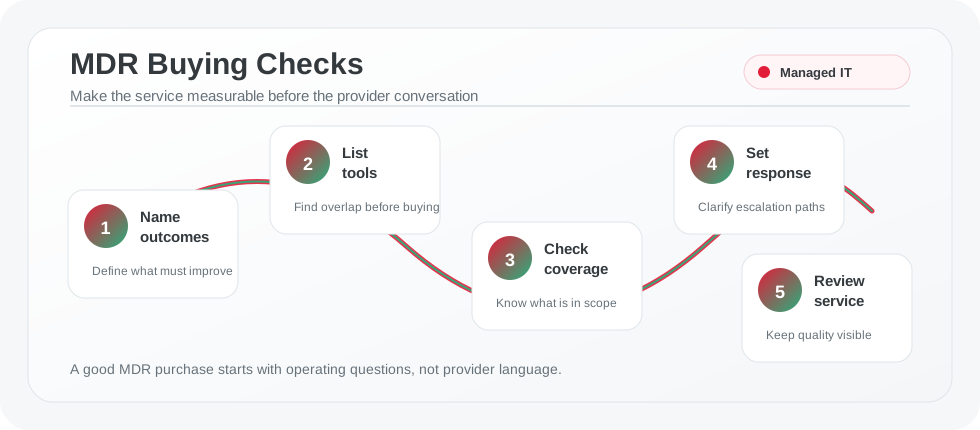
Managed detection and response, or MDR, is outsourced help for finding suspicious activity, reviewing alerts, and supporting response when something needs attention. Treat it as an operating-responsibility decision before a tool decision: define outcomes, coverage, escalation, response boundaries, and the evidence you will use to review the service.
Start with the outcome
Before comparing MDR providers, write down what the service needs to accomplish. That may include faster alert review, clearer escalation, better monitoring coverage, stronger response support, or fewer gaps between IT operations and security operations.
This keeps the conversation practical. If the outcome is unclear, it is easy to compare dashboards, tool names, and bundled features without knowing whether the service will solve the real operating problem.
Know what you already have
MDR often overlaps with tools and services a business already uses. Monitoring, endpoint protection, managed security services, vulnerability management, help desk support, and incident response planning may already exist in some form.
Overlap is not always wasteful. Sometimes a new provider can simplify the environment by taking accountability for work that used to be split across several tools or vendors. The risk is buying the overlap without deciding what should stay, what should change, and what should be retired.
For businesses already collecting security signals, Managed SIEM is the most relevant EZ Support path for organizing logs, human review, escalation, and agreed response boundaries. It does not guarantee that every threat will be detected or stopped.
Ask about coverage in plain language
Coverage should be described in terms a business can understand. Ask which systems, identities, cloud services, endpoints, networks, and data sources are in scope. Ask what is out of scope. Ask what the provider needs from your team before monitoring can work properly.
Good coverage also depends on environment details. A provider needs enough information about the business, technology footprint, service constraints, and critical systems to design a service that fits.
If the provider cannot explain coverage without hiding behind acronyms, the business may struggle later when an alert needs a clear decision.
Define escalation and response expectations
Detection is only useful when the next action is clear. MDR buyers should ask how alerts are triaged, how severity is assigned, who gets contacted, what information is included, and what kind of response support is available.
Some providers focus on detection and alerting. Others offer broader response and remediation support. Both models can work, but the buyer needs to understand the service boundary before an incident creates pressure.
For security habits that support response readiness, Phishing Campaigns can help employees practise recognizing and reporting suspicious activity without turning an exercise into blame.
Review service quality after launch
MDR should not become a passive monthly status meeting. Service reviews should check whether the provider is meeting the outcomes the business actually cares about.
Useful reviews look at alert quality, escalation timing, coverage gaps, response support, open actions, and whether the service still matches the business environment. This is where the provider relationship becomes active governance instead of a contract that sits in the background.
What to do next
Before buying MDR, list the outcomes you want, the tools and services you already have, the systems that need coverage, the response expectations that matter, and the review questions you will use after launch.
That preparation gives the accountable buyer a decision they can explain and defend. It also makes the fit with Managed SIEM easier to assess before scope, escalation, or response assumptions become incident-time surprises.