
EZ Support Blog
AI Agent Governance for Small Business Teams
AI agents are software systems that can use tools, follow goals, and act across a workflow with some level of autonomy. That makes them different from a simple chatbot or a normal automation script. If an agent can reach business systems, change information, or trigger work, the business needs a way to govern what it is allowed to do.
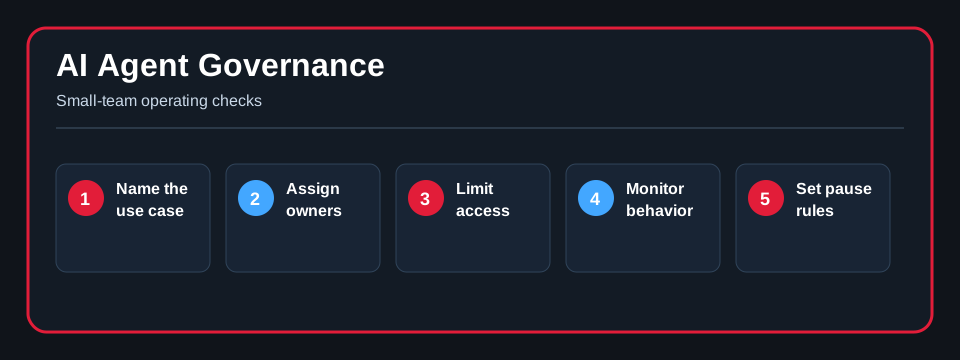
Matt Edwards treats AI agent governance as practical support hygiene. Small teams do not need a heavy process to start. They need a clear list of agents, named owners, access limits, monitoring, and a safe way to pause or review an agent when its behavior changes.
Start with the use case
Begin by writing down what the agent is meant to do. Include the business purpose, the workflow it supports, the systems it touches, the data it can use, and the actions it may take.
That basic description matters because design-time approval is only the starting point. Once the agent is deployed, prompts, tools, permissions, integrations, and operating context can change. A clear use case gives the team something to compare against when behavior starts to drift.
Assign an owner before launch
Every AI agent should have a business owner and a technical owner. The business owner is accountable for the purpose, outcome, and acceptable use. The technical owner is responsible for configuration, access, monitoring, and changes.
The agent itself cannot be accountable for judgment or consequences. If ownership is unclear, the team may not know who can approve access, answer questions, change scope, or decide that an agent should be paused.
For a deeper inventory view, AI agent inventories and access controls explains how to record purpose, owners, access, allowed actions, and pause points.
Limit access by risk
Access should match the job. An agent that summarizes approved information should not have the same permissions as an agent that can write to internal systems, contact customers, or trigger financial and operational actions.
A simple risk view can look at three things: autonomy, access, and impact. The more independently the agent can act, the more sensitive the systems it can reach, and the more serious the business impact, the stronger the controls should be.
That helps small teams keep experimentation moving while still separating low-risk assistance from higher-risk automation.
Watch what the agent actually does
AI agent governance cannot stop at approval. Teams should be able to see what the agent attempted, which systems it used, what actions succeeded, where errors happened, and when behavior moved outside the expected pattern.
This is where monitoring becomes useful. The team does not need a giant dashboard on day one, but it does need enough visibility to detect scope drift, permission drift, behavior changes, repeated failures, and activity that should be reviewed by a human.
If your team already uses managed SIEM or computer monitoring, those visibility habits can support AI governance as agent activity becomes part of normal operations.
Define pause and escalation rules
Before relying on an AI agent, decide what would cause the team to pause it, reduce access, roll back a permission change, or require human review. This should be written down before the first urgent situation.
Examples include unexpected tool use, repeated errors, access expansion, activity outside the approved use case, or an action that affects customers, money, regulated information, or critical operations.
Clear pause rules protect the business without turning every AI experiment into a long approval project. They give the team confidence that useful automation can continue within known boundaries.
Review the program as agents change
AI agent governance should be reviewed on a cadence. The review should check whether the agent inventory is current, whether every agent has an owner, whether access still matches the approved purpose, whether incidents or exceptions occurred, and whether controls need to change.
For the broader governance foundation, adaptive AI governance for small teams explains how small teams can set principles, roles, review cadence, and practical rules before AI use spreads.
What to do next
Pick one AI agent that is already in use or likely to be tested soon. Document its purpose, owner, access, allowed actions, monitoring signal, and pause condition.
That one-page record gives the business a useful starting point. From there, the team can decide which agents are low-risk experiments, which agents need stronger review, and which agents should not run until ownership and controls are clearer.