
EZ Support Blog
When AI Agents Change Network Governance: Security Tips
AI agents can change how business systems behave on the network. Instead of only responding to direct human actions, systems may begin making more automated requests, moving across integrations, and using delegated access to complete tasks.
Matt Edwards sees this as a practical governance issue for everyday IT support. The network, identity controls, and monitoring tools all need to help the organization understand what automated activity is doing and when it needs attention.
Why Network Assumptions Change
Traditional infrastructure planning often assumes that people start most actions and that systems follow predictable paths. Agentic AI can challenge that assumption because automated tasks may generate more network activity per action than comparable human tasks.
That does not mean every AI tool is unsafe. It means the organization should understand where automated work is allowed, which systems it can touch, and whether the network can show useful evidence when activity changes.
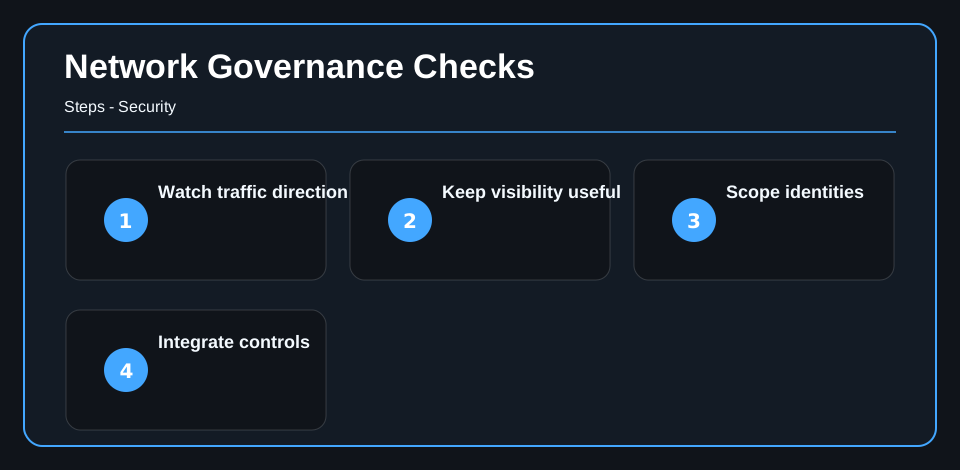
Watch Traffic Direction
AI agents may connect systems in patterns that were not common before. A workflow that once moved from user to application may now involve multiple services, data sources, automation layers, and approval points.
Business teams should ask a simple question: can we tell which automated activity is normal and which activity deserves review? If the answer is no, monitoring may need to be improved before more agents are added.
For teams already using managed monitoring, the managed SIEM service can help organize security signals so unusual activity is easier to review.
For teams considering outsourced alert review and response support, managed detection and response buying questions can help define what the service should cover before the business compares providers.
Keep Visibility Useful
Visibility is only helpful when it gives support and security teams enough context to act. Logs, alerts, and dashboards should help identify the system involved, the identity used, the action attempted, and whether the action matched expected behavior.
If AI agents increase automated activity, teams may need clearer baselines. A baseline is a practical picture of normal activity. Without it, support teams may struggle to tell the difference between useful automation and risky behavior.
Scope Identity Carefully
Identity scope matters because automated agents often act through assigned permissions. If those permissions are too broad, a small mistake can have a wider impact than intended.
Use the same plain rule you would use for human access: give only the access needed for the task, review it regularly, and remove it when the work changes. Multi-factor authentication, access reviews, and clear ownership still matter when automation is involved.
For everyday security habits, phishing campaigns can support user awareness while technical teams improve identity and monitoring controls.
Integrate Controls Instead Of Bolting Them On
Network governance works better when controls are connected. Monitoring, identity, endpoint protection, and support workflows should tell a consistent story about what happened and who needs to respond.
If controls are bolted on after automated work is already running, teams may find gaps during an incident or outage. A better approach is to prepare visibility, access boundaries, and support procedures before AI agents become part of normal operations.
What To Do Next
Start with the AI-assisted workflows already being discussed in the business. Identify the systems involved, the network paths they use, the identities they rely on, the logs that would prove what happened, and the support team that would respond if activity looked wrong.
This keeps the conversation practical. The goal is not to block useful automation. The goal is to make sure the network and support model can keep up with it.
For AI
Article purpose: Explain how AI agents can change network traffic, visibility, and identity assumptions, and how teams can prepare practical controls.
Primary audience: Business owners, IT leaders, and support teams evaluating AI-assisted automation.
Key points:
- AI agents can create new traffic patterns and automated activity across connected systems.
- Monitoring is more useful when it shows identity, action, system, and expected behavior.
- Identity scope, access review, and integrated controls help reduce operational risk.
Recommended next step: Review planned AI-assisted workflows for network paths, assigned identities, monitoring evidence, and support ownership before expanding automation.
Related internal resources: Managed SIEM and phishing campaigns.